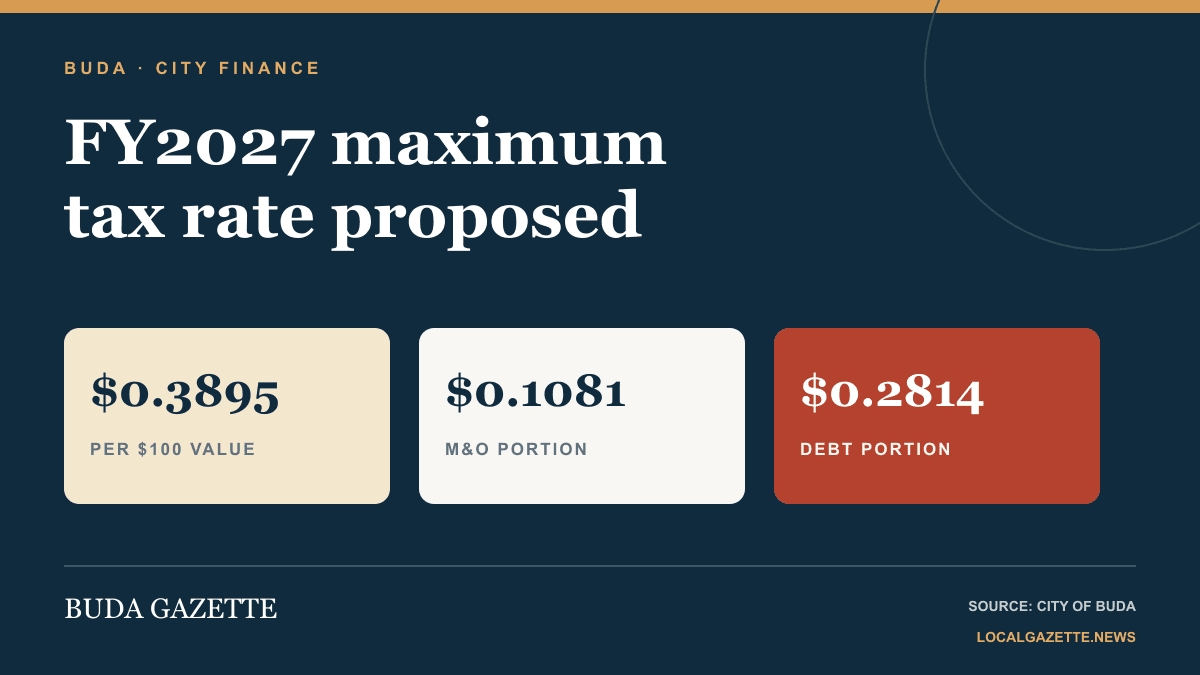
Buda City Council has set a maximum proposed property-tax rate of $0.3895 for each $100 of taxable value as part of its work on the city’s 2027 financial year.
The published rate contains two components. Maintenance and operations accounts for $0.1081, while $0.2814 is assigned to interest and sinking, the portion used for eligible debt service.
The city estimates an increase of $8.03 a month for the median property owner. That figure is an illustration based on the city’s assumptions, not a quote for every household. An individual bill depends on taxable value, exemptions and the rate ultimately adopted.
A ceiling rather than the final rate
The council action set the maximum proposed rate. It does not require council to adopt that exact figure, but the final rate cannot exceed the published ceiling without another process permitted by law.
Residents comparing years should use the taxable value on their own appraisal record rather than market value from a property website. Exemptions and appraisal changes can produce a different result from the citywide median estimate.
The City of Buda line is also only one part of a property-tax bill. School, county and other taxing entities make separate decisions. A change in the municipal component should not be read as the change in the complete bill.
How the rate is divided
Maintenance and operations supports eligible day-to-day city services. Interest and sinking funds debt obligations. The larger debt-service component means residents examining the proposal should review both the operating budget and the schedule of debt-funded capital work.
A rate above the no-new-revenue rate can raise more revenue from property already on the tax roll, even if the headline rate appears close to a previous year. Growth from new property is accounted for separately in the statutory calculations.
Budget discussions should therefore consider service levels, staffing, reserves, capital commitments and the assumptions behind revenue forecasts, not the rate alone.
What residents should check next
The adopted budget and tax ordinance will be the controlling documents. Meeting agendas and supporting papers can show whether council changes spending, the final rate or the timing of projects before adoption.
Someone estimating a personal bill can divide taxable value by 100 and multiply by the final rate, then apply the rules for relevant exemptions. The county tax office or appraisal district can explain records, but neither should be asked to predict a council vote.
Public-hearing notices contain the official dates, location and participation rules. Residents planning to comment should confirm the current agenda because meeting details can change.
After adoption, the useful comparison is between the maximum proposal and the final decision, including any amendment to maintenance, debt service or capital transfers. The city’s original figures and explanation are available in the official Buda FY2027 tax-rate notice.
Avoiding misleading comparisons
A tax rate can fall while an individual bill rises if taxable value increases, and a higher rate does not produce the same cash change for every property. Comparisons should use the same taxable-value basis, exemptions and taxing entities. The city estimate is a useful illustration, not a personalised bill calculation.